

Digital activity can grow while direction disappears
Digital marketing often becomes fragmented long before anyone notices the damage. One person manages the website. Another handles SEO. A designer creates social posts when needed. Someone else runs an occasional campaign. Each person may be doing competent work, but the brand still feels inconsistent. The website says one thing, Instagram suggests another, and the content changes direction from week to week. There is activity everywhere, yet no clear movement.
This is usually the point at which a business starts looking for a digital marketing consultant. In my view, however, it is already later than it should be.
The best time to involve a consultant is not when sales have fallen or when several disconnected activities have failed. It is when the first serious idea for the business appears—sometimes even before the brand has a name. That is when positioning, market opportunity, identity, website architecture, search visibility and social communication can be designed around the same commercial direction.

The value is not that every task passes through one pair of hands. It is that every task moves through one strategic channel.
A consultant is not another disconnected supplier
A digital marketing consultant should not simply add another report, channel or list of recommendations to an already fragmented operation.
The real role is to understand the whole system, define where it needs to go and coordinate the people responsible for getting it there. That includes breaking the work into the right parts, matching each responsibility to the strongest available specialist and maintaining control of the strategy, priorities and standards across the project.
I do not expect the same person to be the best researcher, strategist, designer, developer, SEO specialist, copywriter and social media producer. That is rarely realistic. The consultant’s job is to understand the capabilities of the team, assign work intelligently and identify the gaps or faults that appear between disciplines. If a role is not producing the required standard, the process needs to change—and sometimes the person responsible needs to change too.
The value is not that every task passes through one pair of hands. The value is that every task moves through one strategic channel.
Explore digital marketing strategy↗The work begins with the market, not the content calendar
Before planning a website or publishing content, I begin with market research and the current position of the business.
Where does the company sit among its competitors? What does the market already understand about it? Which claims have become generic? Where are the gaps that competitors have ignored? What does the intended customer need to see, believe or compare before taking the next step?
These questions shape the architecture that follows. A website should not be designed first and given a strategy later. Its structure, hierarchy and conversion paths should grow from a clear understanding of the market and the position the business can credibly own.
The same is true for SEO and social media. Search content cannot compensate for an unclear offer. A polished Instagram account cannot repair a brand that changes personality on every platform. Paid reach cannot create lasting confidence if the destination does not support the promise that attracted the click.
Research is therefore not a preliminary document that gets archived once production begins. It is the benchmark against which later decisions are made.
- Locate the business among real competitors
- Identify market gaps before defining channels
- Build website architecture from position and buyer decisions
- Keep later execution accountable to one strategic benchmark
Why connected execution produces a more distinctive result
When the website, search strategy, content and social media are managed as separate projects, each team naturally optimizes for its own output. The developer wants the website delivered. The SEO specialist wants rankings and traffic. The social team wants reach and engagement. The designer wants visual consistency. None of these objectives is wrong, but none is sufficient on its own.
The business needs them to converge on a shared result. That is why I treat digital marketing as an ecosystem. The brand position determines the message. The message shapes the website. The website creates destinations for search and campaigns. Search reveals demand and language that can improve content. Social media builds familiarity, tests ideas and gives the brand a recognisable public rhythm. Measurement then shows where attention is turning into trust, enquiries and revenue—and where it is not.
Modern customer journeys are rarely linear. People move between searching, scrolling, watching, comparing and buying, often across several platforms. That makes coordination more important, not less. A customer should not feel that they are meeting a different business each time they change channels.
Explore social media strategy & management↗VCC Carpet: turning cultural identity into a repeatable content system
The work with VCC Carpet gives a useful example of what connected direction can produce, even when the main field of execution is one platform.
The central focus was Instagram. Instead of treating the account as a catalogue of carpets or publishing unrelated posts based on short-term trends, we developed a recognisable brand character: an Iranian woman shaped by the visual language of traditional Iranian culture and dress.
She was not added as decoration. She gave the content a consistent point of view. The character connected the product category with memory, identity, colour, storytelling and cultural familiarity. This created a repeatable creative territory in which different Reels could still feel like parts of the same brand.
One Reel published on 26 November 2025 reached 1,016,600 views. Instagram Insights recorded 82,205 interactions, including approximately 62,000 likes, 2,100 comments, 9,100 sends, 2,500 reposts and 6,100 saves. It also generated 499 profile actions. Two other visible Reels reached approximately 446,000 and 137,000 views.
A separate follower report for 8 January to 24 February recorded 4,260 followers and 43% growth compared with 7 January. During that period, the account gained 1,439 follows and lost 112, producing net growth of 1,327 followers.
These numbers matter, but they need to be interpreted honestly. They demonstrate substantial reach, interaction, sharing behaviour, profile interest and audience growth. They do not, by themselves, prove a specific amount of revenue. Without verified sales and attribution data, I would not present one million views as one million units of business value.
The more defensible lesson is that a clear cultural concept, consistent art direction and coordinated production system gave the audience something recognisable enough to watch, share, save and follow. The viral result was not the strategy. It was one visible outcome of the strategy.
Read the VCC Carpet case study↗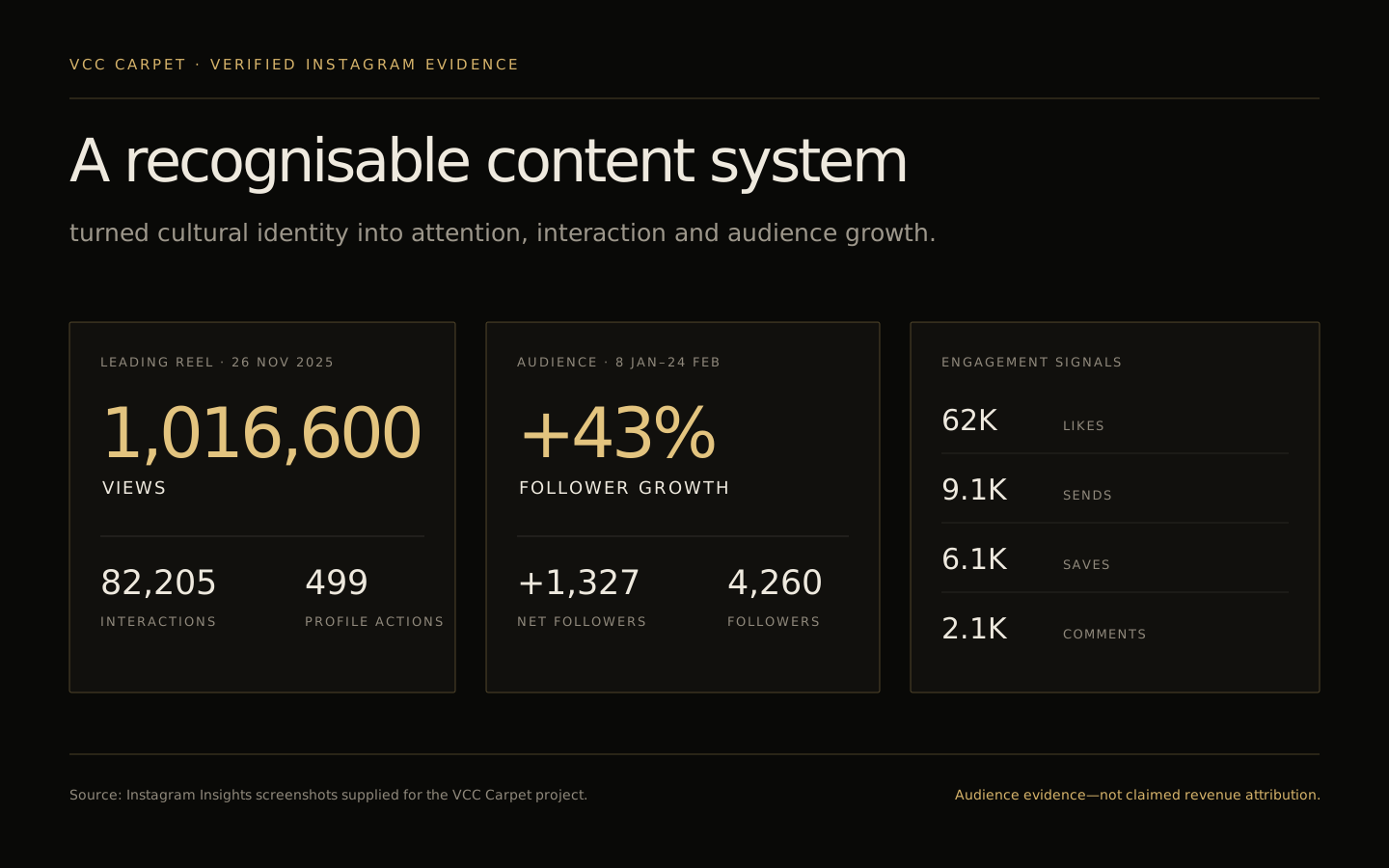
The evidence demonstrates attention, interaction and audience growth. It is not presented as verified revenue attribution.
When should a business hire a digital marketing consultant?
Many companies wait for declining sales. By then, the consultant is being asked to diagnose a system after the damage has become visible.
The stronger moment is earlier: when the business idea is first being tested, before choosing the brand name, before the website structure is approved, before separate suppliers establish conflicting directions, when entering a new market, before investing heavily in content, SEO, social media or advertising, or when a growing internal team needs one senior direction across several disciplines.
Google makes a similar point specifically about SEO: when a company is considering a redesign or launching a new website, the earlier it involves the right expertise, the better. The principle is broader than search. Early strategic decisions are usually less expensive to improve than a completed system built on the wrong assumptions.
A consultant is not only there to repair failure. The better use of consultancy is to prevent avoidable fragmentation and make the first important decisions with a wider view.
- At the idea and naming stage
- Before website architecture and channel execution
- Before entering a new market
- Before significant content, SEO, social or advertising investment
- When several teams need one senior direction
Marketing as a cost—or as an investment
In my experience, many Iranian managers still approach SEO and social media as if they were magic tools. Work begins today, so visible results are expected tomorrow. When that does not happen, marketing is quickly classified as an expense that failed.
I have generally found the attitude among Turkish managers more investment-oriented. This is not a universal rule, and there are informed and uninformed decision-makers in every market. But marketing investment appears to be more established in the way many Turkish businesses think about growth.
The difference matters because serious marketing needs time to collect information, establish a position, produce assets, reach the right people and learn from their response. Even technical SEO changes can take anywhere from hours to months to be reflected in Google, and Google recommends allowing several weeks before assessing many changes.
Patience does not mean passive waiting. It means continuing to research, produce, measure and improve without destroying the strategy every time a short-term graph moves in the wrong direction.
No single metric is enough
Reach matters. Visibility matters. Trust matters. Engagement, qualified leads and sales matter too. Each is necessary in the right context, but none is enough alone.
A million views without relevance can disappear without changing the business. A high Google position for the wrong query can bring traffic without opportunity. A visually impressive website can win admiration while confusing the buyer. Short-term sales can rise through aggressive promotion while weakening the brand’s long-term value.
The measurement system therefore needs to reflect the job of each channel and the commercial objective they share. Social content may build recognition and audience response. SEO may create durable discovery. The website may turn that discovery into understanding and trust. A strong offer and sales process then convert qualified interest into revenue.
The consultant’s responsibility is to keep those signals connected and to distinguish progress from noise.
Explore SEO, GEO & AEO consulting↗Patience is the first principle
My first principle in marketing is patience.
I think of marketing as a hunter waiting in position—not inactive, but alert. The hunter studies the environment, understands movement and waits for an opening. In business, that opening may be an unmet need, a change in customer behaviour or a mistake a competitor has failed to notice.
The decisive move only works because of the observation and preparation that came before it. This is why constant, directionless activity is not the same as momentum. A connected digital marketing system can move quickly when the right opportunity appears because the research, position, team and channels are already aligned.
The purpose of a consultant is not to make the business look busy. It is to make sure that when the market creates an opportunity, the business is ready to act with clarity.
Questions this answers
What does a digital marketing consultant do?+
A digital marketing consultant researches the market, defines positioning and priorities, coordinates specialists and connects the website, SEO, content, social media and measurement around shared business objectives.
Is a digital marketing consultant the same as an agency?+
Not necessarily. An agency usually provides an execution team and defined services. A consultant may work above and across internal staff, agencies and freelancers, directing strategy, assigning responsibilities and maintaining standards between disciplines.
When is the best time to hire a digital marketing consultant?+
Ideally, when the business idea and brand are still being shaped—before naming, website architecture and channel execution become expensive to change. A consultant can also help during repositioning, market entry or periods of fragmented growth.
How long does digital marketing take to produce results?+
There is no responsible universal promise. Some content can gain rapid reach, while brand trust, search visibility, qualified demand and revenue usually develop over a longer cycle of execution and learning.
Is social media growth a business result?+
It is meaningful when it improves relevant reach, engagement, audience quality or movement toward a commercial action. It should not automatically be presented as revenue unless sales and attribution data support that claim.