

The first mistake is treating visibility like a magic trick
When I speak with business owners about search, the conversation often begins with rank. They want to know how quickly a page can reach the top, as if the position itself were the commercial result. GEO is usually unfamiliar. AEO is even less familiar. SEO is the known term, but it is frequently understood as a switch someone can turn on today and expect extraordinary results from tomorrow.
That expectation creates the wrong brief. It encourages isolated tactics, impatient decisions and reporting built around movement rather than meaning. A page can gain positions for a query that brings no relevant buyer. A graph can rise while the business remains no easier to discover, understand or choose.
I prefer a harder but more useful question: are we building visibility that can keep producing the right kind of discovery? Sustainable growth matters more than a short-lived jump. That principle is where SEO, GEO and AEO begin to make sense together.

Search, answers and generative discovery become more valuable when they converge into one credible source of truth.
SEO creates the conditions for discovery
Search engine optimization is the foundation. It helps search engines access a website, understand its pages and connect those pages to the language people use when they look for an answer, service or solution.
Good SEO is partly technical: crawlability, indexing, performance, canonical signals, structured navigation and clean page architecture. It is also editorial and commercial. The site needs pages that correspond to real questions and decisions, not simply a collection of keywords arranged for a crawler.
This is why ranking cannot be the only measure. The more useful signals are whether relevant pages are being discovered, whether impressions are appearing for the right subjects, whether new queries are emerging and whether those visits can move toward trust or action.
- Make important pages accessible and indexable
- Connect search demand to a clear page architecture
- Use language that reflects real questions and buying decisions
- Measure the quality and durability of discovery—not position alone
AEO makes the answer easier to use
Answer engine optimization is a useful name for the work of making information clear enough to be retrieved as an answer. The idea existed before generative AI through featured snippets, voice search and question-led results. It has become more visible now because assistants increasingly respond directly instead of presenting only a list of links.
AEO does not mean reducing every page to a stack of short definitions. It means understanding the question behind the visit and answering it without unnecessary friction. A direct opening, a precise comparison, a transparent process or a genuinely useful FAQ can all help—provided the answer remains accurate and connected to its context.
The strongest answer is not always the shortest one. It is the one that resolves the immediate question and gives the reader enough evidence to trust what comes next.
- State the question or decision clearly
- Give the useful answer before adding unnecessary explanation
- Preserve nuance, evidence and limitations
- Use headings and supporting structure to make meaning easier to retrieve
GEO makes expertise usable in a generated response
Generative engine optimization focuses on visibility inside systems that synthesize information from several sources. The term is newer than SEO and its exact boundaries are still developing, but the practical concern is clear: can a generative system find the content, understand what it is about and treat it as a source worth drawing from?
This shifts attention from keywords alone to source quality. Original experience, precise claims, named entities, clear authorship, relevant evidence and consistent information across the web all matter. A generic article that repeats what every other page says gives a generative system little reason to select it.
GEO is therefore not a licence to write for machines. It is pressure to become more specific for people. The content needs a point of view, a reason to exist and enough clarity that its meaning survives when it is summarized.
Three labels, one operating system
The labels describe different moments in discovery, but the underlying work overlaps. SEO helps a page enter and compete within search systems. AEO helps the page resolve a question cleanly. GEO helps the underlying expertise become understandable and usable when an AI system constructs a response.
In practice, a technically inaccessible page cannot become a dependable answer. A thin answer is unlikely to become a credible source. And a credible source that is disconnected from the site’s architecture may never be discovered consistently. Treating the disciplines as separate services often creates three partial solutions to one problem.
Google now makes a similar point in its guidance for generative search: foundational SEO still applies, while special AEO or GEO hacks are not a substitute for crawlable pages and valuable, original content. The terminology can help teams organize the work, but it should not fragment the strategy.
- SEO: be found and understood
- AEO: answer the question clearly
- GEO: become a credible source for synthesis
- Business outcome: earn relevant, sustainable discovery
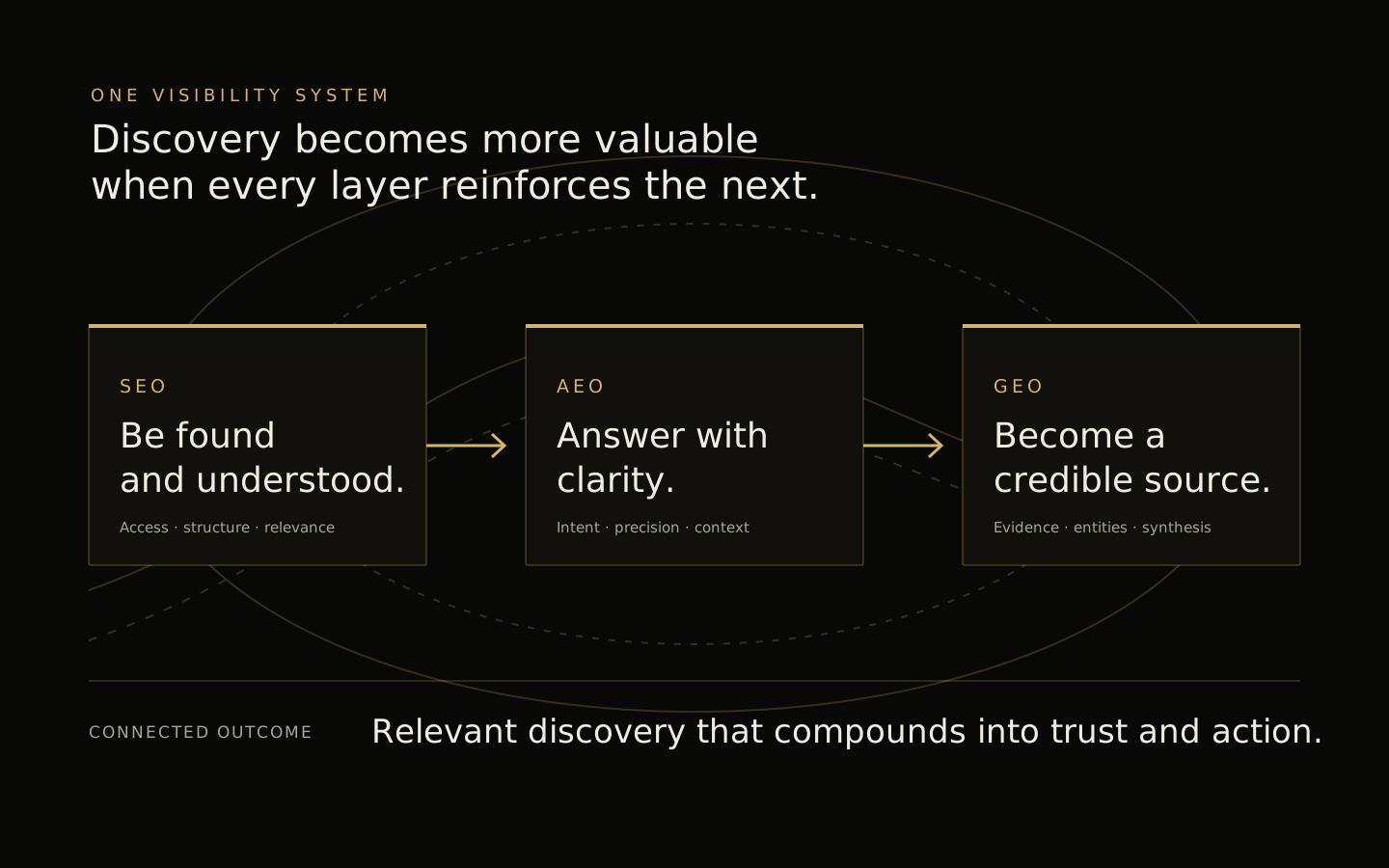
SEO, AEO and GEO describe different moments in discovery, but they depend on the same connected foundation.
What Marina Swim School taught me about sustainable growth
I received access to the Marina Swim School website in October 2025. The site had been online for roughly fourteen years, so the job was never going to be as simple as choosing a few keywords. The initial review found mobile layout problems, a navigation structure that did not support search intent, indexing issues and approximately 76 published pages without a clear role in the wider site. Before trying to create more authority, we first had to reduce the ambiguity already inside the system.
The work began with technical and indexing corrections, including the treatment of broken and unnecessary URLs. Search Console later showed affected 404 pages falling from 47 to 33. We reviewed the page structure, clarified the roles of programs, audiences and locations, produced and optimized content, strengthened internal links and used structured data where it accurately described the visible page. None of these actions was dramatic on its own. Their value came from the way they reinforced one another.
There was also pressure to accelerate the project through purchased backlinks. I was not against links; I was against treating purchased links as the strategy. A backlink cannot repair a confused architecture, make a weak page useful or turn an unclear offer into a credible answer. My recommendation was to keep building organic authority through a technically sound website, deliberate content, useful internal connections and links earned or placed with a defensible editorial reason.
The fourth-month report gave us a more meaningful view of the result. In Search Console, the latest three-month period was compared with the same period a year earlier. Clicks increased from 1.32K to 3.76K—about 185%. Impressions increased from 37.6K to 259K—about 589%. Average position improved from 27.1 to 13.1. The site was not merely moving for one tracked phrase; it was appearing across a much wider field of relevant searches.
The same report contained a less flattering number, and it matters. CTR fell from 3.5% to 1.5%. I do not see that as a reason to hide the data or dismiss the growth. Visibility had expanded much faster than clicks as the site entered a broader mix of queries. It showed us where the next cycle of work needed to focus: search intent, titles, descriptions, snippets and the pages attracting new impressions. Growth had created the next optimization problem.
The engagement concluded in February 2026 before that next cycle could be completed. That timing is important. It would be inaccurate to claim that stopping the work caused the CTR decline; the comparison had already been recorded. What I can say is that the project ended with a larger organic footprint and a clearly defined next step, rather than a finished graph presented as permanent success.
This is what I mean by a real SEO result: not a screenshot from one unusually good day and not a rank purchased at the expense of the foundation, but a durable pattern of relevant discovery that becomes more useful as the system is refined.
Read the Marina Swim School case study↗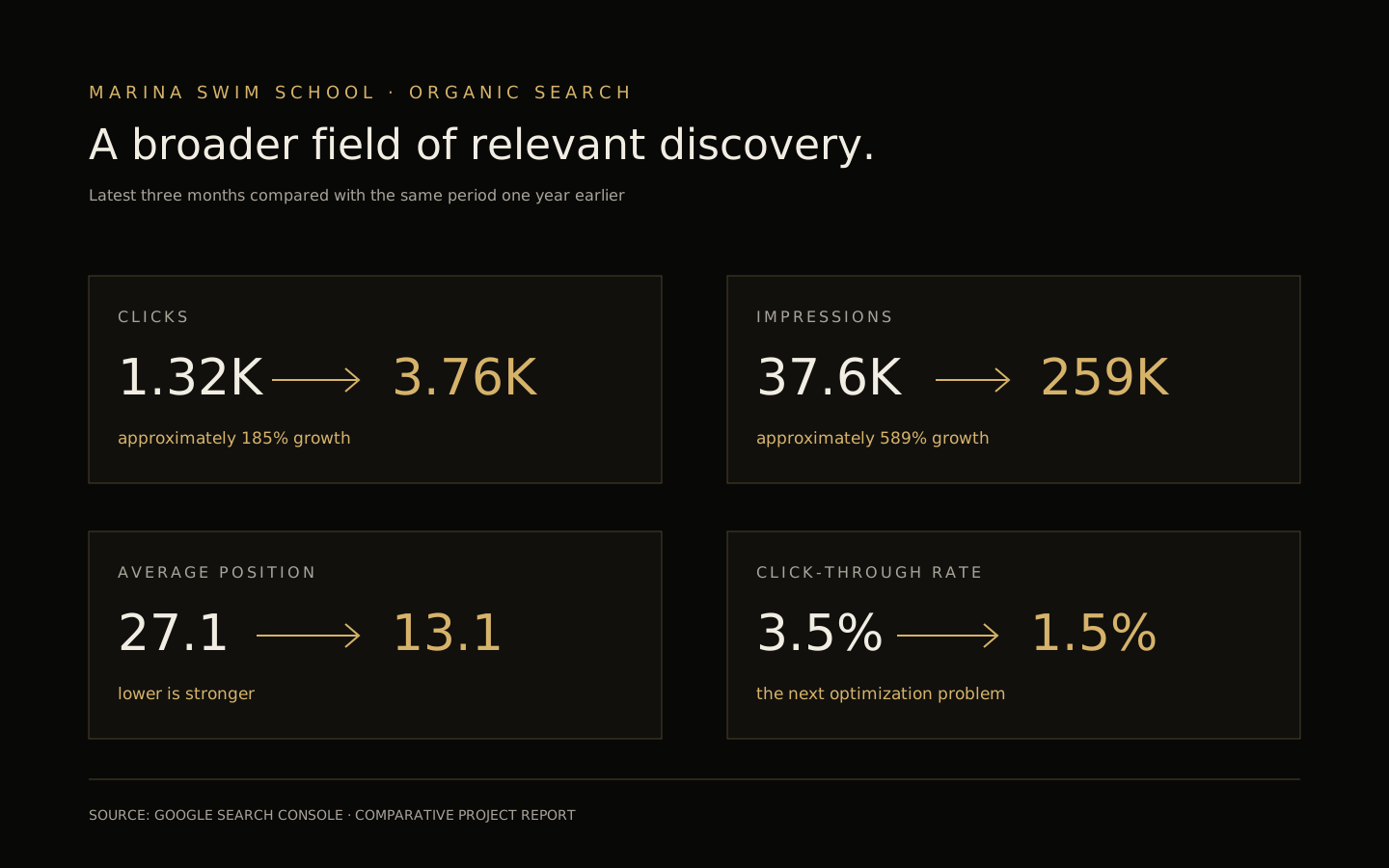
The wider organic footprint was real. The lower CTR was equally useful evidence for the optimization cycle that needed to follow.
Schema is useful. It is not the strategy.
Structured data helps machines interpret what a page represents. It can clarify relationships between an article, a person, a service, an organization or a breadcrumb path. That makes it valuable—but only when it accurately describes content people can actually see.
It does not create expertise, repair weak information architecture or make a generic claim credible. There is also no special schema required to appear in generative search. The same applies to many fashionable shortcuts: machine-readable extras cannot compensate for pages that say nothing distinctive.
I use schema as part of the infrastructure. I do not use it as a substitute for the work the infrastructure is supposed to support.
A practical way to build the system
Start with the business decision, not the acronym. Decide who needs to discover the company, what they are trying to understand and what a useful next step looks like. Then make sure the website has a technically sound and crawlable foundation.
Build definitive pages for the services, subjects, locations, methods and proof that matter. Connect them through internal links that make sense to a reader. On each page, answer the central question clearly, then support the answer with experience, evidence and honest limitations.
Finally, measure the system over a meaningful period. Look for relevant query growth, impressions across the right subjects, stronger discovery of priority pages, engaged visits and qualified actions. Use those signals to improve the next page, not to manufacture a victory report.
- Define the commercial question
- Repair crawl, index and technical foundations
- Design pages around entities, intent and decisions
- Publish clear answers supported by original experience
- Connect the knowledge through useful internal links
- Review sustainable trends and improve deliberately
The objective is not to win an acronym
SEO, GEO and AEO will continue to evolve, and the industry will continue producing new labels around them. A business does not need to chase every label. It needs a reliable source of truth that can be found, understood and trusted wherever discovery begins.
If the work improves only ranking, it is incomplete. If it makes the company easier to discover but not easier to believe, it is incomplete. If it produces a clear answer without a meaningful next step, it is incomplete.
The goal is a connected system that earns attention for the right reasons and compounds over time. That is less dramatic than a magic wand. It is also far more useful.
Questions this answers
Does GEO replace SEO?+
No. GEO depends on many of the same foundations as SEO: crawlable pages, clear architecture, useful content, identifiable expertise and credible evidence.
What is the difference between AEO and GEO?+
AEO focuses on making information easy to retrieve as a clear answer. GEO focuses on making expertise understandable and credible enough to be used within a generative response. In practice, the work overlaps.
Do I need special schema for AI search?+
No. Structured data can reduce ambiguity and support eligible search features, but there is no special schema required for generative AI visibility.
How quickly should SEO produce results?+
There is no responsible universal promise. Technical changes may be detected quickly, while sustainable query, impression and commercial growth depends on the site, market, competition, content and authority.
What should a business optimize first?+
Begin with the commercial question and technical accessibility. Then create a clear page architecture, useful answers, original evidence and internal links before pursuing channel-specific tactics.